

CommentaryFTC Record
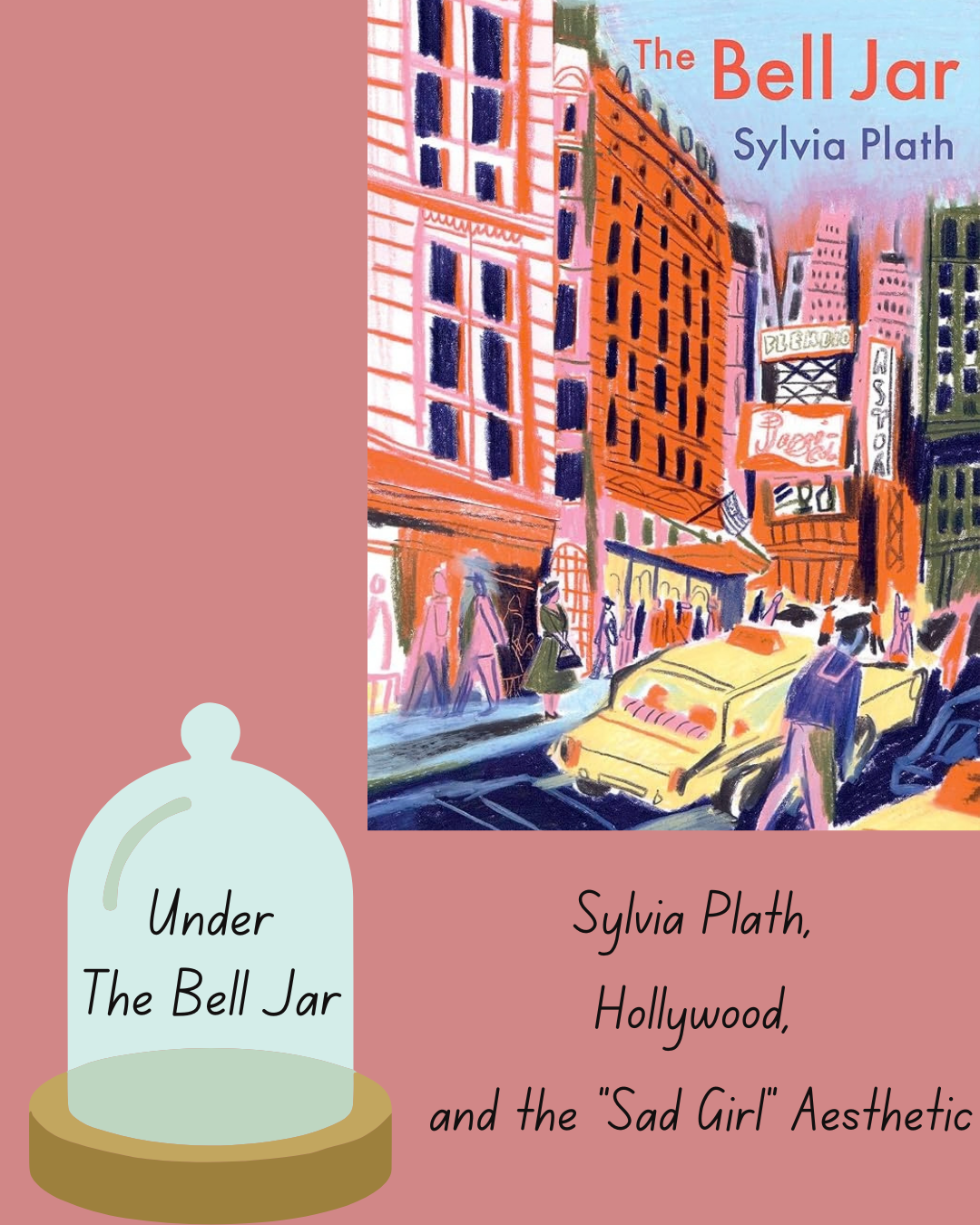
Under The Bell Jar: Sylvia Plath, Hollywood, and the “sad girl” aesthetic
By Grace Bonamico
More than 60 years after Sylvia Plath published The Bell Jar, the semi-autobiographical novel is headed back to the big screen, this time with Sarah Polley directing and Billie Eilish making her acting debut as Esther Greenwood. Production on the film wrapped earlier this month, although a release date has yet to be announced.
The new adaptation, however, arrives in a much different cultural landscape than the novel did in 1963. In the decades since Plath’s death, particularly with the rise of websites like Tumblr, the author and her work have become intertwined with an online “sad girl” aesthetic. At times, that image can blur the line between engaging with Plath’s writing and romanticizing the mental illness depicted in it.
“I think she’s often reduced to and lumped in with other ‘sad girl’ artists,” said Julie S., an avid and longtime reader of Plath’s work. “Lady Lazarus would be featured in the same 2014 Tumblr blog filled with Lana Del Rey lyrics, Girl, Interrupted scenes, and blurry pictures of women in pink dresses with cigarettes and knives.”
Julie said reading The Bell Jar has become something of “a teenage girl rite of passage,” while Plath herself has increasingly become a cultural symbol. “Sylvia Plath is almost thought of as a martyr for women’s suffering and depression,” she said. “She’s almost more of a symbol in pop culture today than an artist to critically engage with.”
Part of that image is connected to the deeply personal nature of Plath’s work. “Plath’s writing explicitly captures the experiences of a middle-class white woman in mid-century America through confessional poetry and semi-autobiographical prose, which is specifically derived by personal experience and trauma,” Julie said.
Published under the pseudonym Victoria Lucas just a month before Plath’s death in February 1963,The Bell Jar has since become her best-known work. Frances McCullough, writing in the foreword to the novel’s 25th-anniversary edition, connected the book’s history directly to the circumstances surrounding its author.
“Of course Plath did die a tragic death at the age of thirty, and the book’s subsequent history has everything to do with that fact,” McCullough wrote.
Originally published only in England, copies of the novel began making their way into the United States before its official American publication. “The demand for more Plath had led to bootleg copies of the novel coming in from England; at least two bookstores in New York carried the book and sold it briskly,” McCullough wrote. The Bell Jar was officially published in the United States in April 1971 and went on to become a commercial success.
The novel made its way to movie screens in 1979, but another mainstream adaptation has not made it out of development in the decades since. Kirsten Dunst was once set to make her feature directorial debut with an adaptation of The Bell Jar, but the project ultimately fell through.
“I never had the rights. It was never mine,” Dunst told IndieWire in 2019. “It was a script that was going around forever and with tons of people rewriting it. It just kept dragging on, and not getting financed, and I was like, ‘It’s too much work.’”
Polley’s adaptation now has the chance to introduce Esther Greenwood and Plath’s novel to another generation. At the same time, the film will be arriving with decades of cultural baggage surrounding Plath that simply did not exist when the book was last adapted.
According to J.N. Sprayberry, a journalist who has written about Plath, that is particularly notable with the casting of Eilish, an artist who has herself been associated with the online “sad girl” aesthetic.
“I think the casting of Billie Eilish in particular is notable because she has been someone that has been idolized a little bit by the sad girl community, at least when her music first started to come out,” Sprayberry said. “I think there’s definitely a chance that it could play into people’s expectations for it because it is starring one of the most popular artists of our current time.”
That connection may shape how audiences approach the film, as well as how they understand the depression at the center of Plath’s novel.
“I think that it has the potential to even further alter people’s perception of Plath and The Bell Jar in particular as kind of being this fanciful depiction of melancholy that’s more about the beauty of sadness rather than how deeply emotionally affecting it is,” Sprayberry said. “Which I think is the point of the novel is that it is a crippling sadness and that even though there’s beauty found in it, the beauty does not override the pain that it causes.”
There is also the challenge of turning something as personal as The Bell Jar into a film. Plath’s distinctive voice has to be translated into a visual medium, while filmmakers also have to deal with expectations from readers who may already have their own ideas about what the novel should look like on screen.
“There’s always books that have such a unique writing style that any filmmaker or screenwriter would read it and be like, ‘How the hell am I gonna adapt this?’” said James Fusco, an indie filmmaker. “And there is also that pressure from fans of the book or ‘book purists’ that don’t necessarily engage with the adaptation the way the filmmaker intends and rather just view it as a checklist where they check for every single inaccuracy to later criticize the entire film for, whether that change helped the film or not.”
Until audiences get their first look at Polley’s adaptation, there is no way to know how the film will approach the modern aestheticization of Plath. But more than six decades after The Bell Jar was published, adapting Plath’s novel also means confronting everything that has come to surround it, from Plath’s own legacy to the image of her that generations of readers and internet culture have created.